Time Distortion in ADHD
Two-page infographic comic by Pina “ADHD Alien” Varnel — how ADHD warps the sense of time: a shortened “time horizon”, unreliable time estimation, and the strategies that help. Companion piece to the ADHD Alien comics archive; not part of the numbered series.
Page 1/2
Time Distortion in ADHD
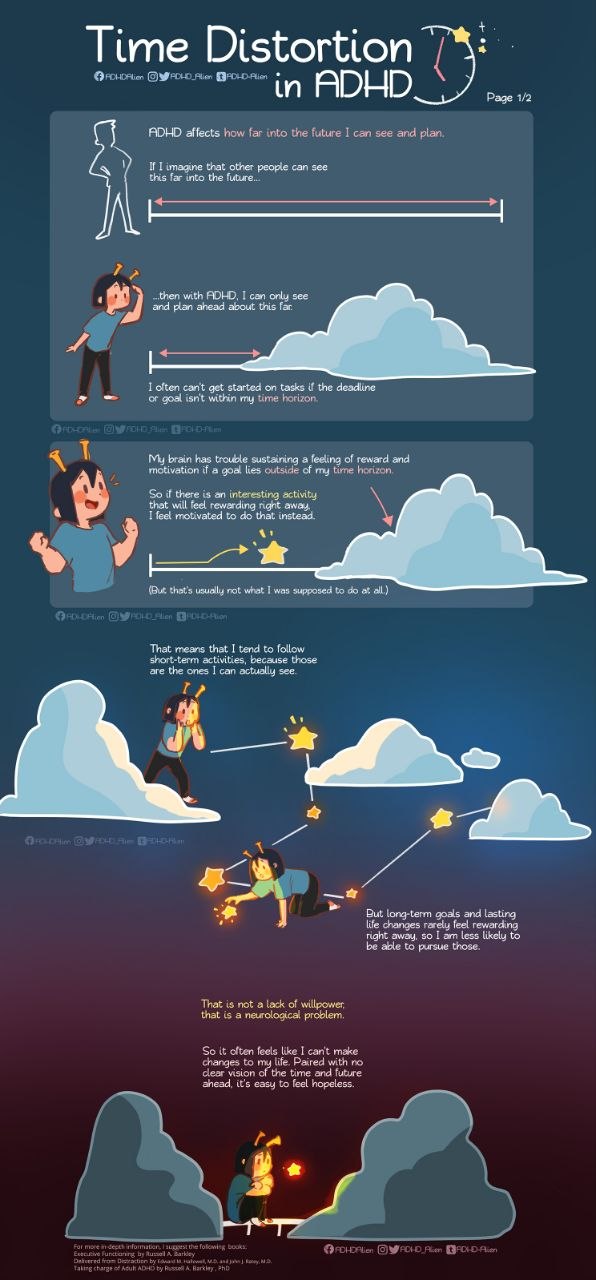
ADHD affects how far into the future I can see and plan.
If I imagine that other people can see this far into the future…
…then with ADHD, I can only see and plan ahead about this far.
I often can’t get started on tasks if the deadline or goal isn’t within my time horizon.
My brain has trouble sustaining a feeling of reward and motivation if a goal lies outside of my time horizon.
So if there’s an interesting activity that will feel rewarding right away, I feel motivated to do that instead.
(But that’s usually not what I was supposed to do at all.)
That means that I tend to follow short-term activities, because those are the ones I can actually see.
But long-term goals and lasting life changes rarely feel rewarding right away, so I am less likely to be able to pursue those.
That is not a lack of willpower; that is a neurological problem.
So it often feels like I can’t make changes to my life. Paired with no dopamine reward for doing something ahead, it’s easy to feel hopeless.
For more in-depth information, I suggest the following books:
- Taking Charge of Adult ADHD by Russell A. Barkley, PhD
- Delivered from Distraction by Edward M. Hallowell, M.D. and John J. Ratey, M.D.
- Executive Functioning by Russell A. Barkley
Page 2/2
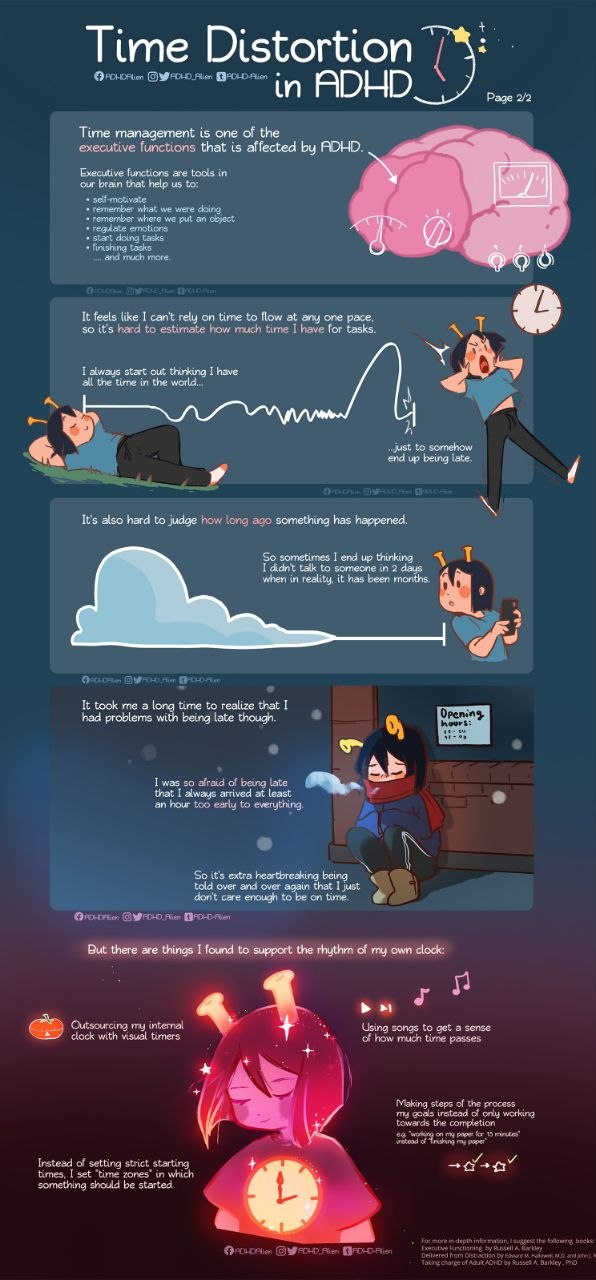
Time management is one of the executive functions that is affected by ADHD.
Executive functions are tools in our brain that help us to:
- self-motivate
- remember what we were doing
- remember where we put an object
- plan ahead and prioritize
- start doing tasks
- finishing tasks
- …and much more!
It feels like I can’t rely on time to flow at any one pace, so it’s hard to estimate how much time I have for tasks.
I always start out thinking I have all the time in the world…
…just to somehow end up being late.
It’s also hard to judge how long ago something has happened.
So sometimes I end up thinking I didn’t talk to someone in 2 days when in reality, it has been months.
It took me a long time to realize that I had problems with being late though.
[Sign] “Opening hours: (?)”
I was so afraid of being late that I always arrived at least an hour too early to everything.
So it’s extra heartbreaking being told over and over again that I just don’t care enough to be on time.
But there are things I found to support the rhythm of my own clock:
- Outsourcing my internal clock with visual timers
- Using songs to get a sense of how much time passes
- Instead of setting strict starting times, I set ‘time zones’ in which something should be started
- Making steps of the process my goals instead of only working towards the completion (This helps me to work on a number of things instead of focusing on one!)
For more in-depth information, I suggest the following books:
- Taking Charge of Adult ADHD by Russell A. Barkley, PhD
- Delivered from Distraction by Edward M. Hallowell, M.D. and John J. Ratey, M.D.
Part of ADHD Alien comics.
[Watermark on every panel] @ADHDAlien / @ADHD_Alien / @ADHD-Alien